Priorities of industrial policy discussed at plenary session
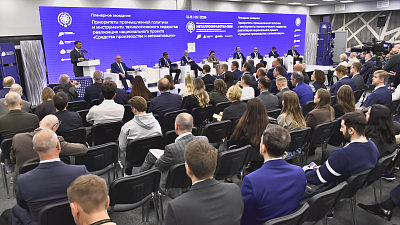
The Plenary Meeting on the Priorities of the Industrial Policy and Technological Leadership Tools: Implementation of the National Project on the Means of Production and Automation has opened the conference programme of Metalloobrabotka 2026. The event is organised by the Russian Ministry of Industry and Trade, the Centre of Basic Industries Development, and EXPOCENTRE AO.
This event is dedicated to discussing the goals, objectives and mechanisms for the implementation of a national project aimed at ensuring Russia's technological independence in the field of high-tech machine tool production and increasing the level of industrial robotics.
The Means of Production and Automation national project was launched in 2025. Its main goal is to ensure Russia's technological leadership in the production of high-tech machine tools and to increase the level of industrial robotics. Among the key objectives is to achieve 95% technological independence in the manufacture of production equipment by 2030 and become one of the top 25 countries in terms of robotics density.
The project implements various support measures, including subsidies for R&D, compensation of discounts to manufacturers, preferential loans, grants, and other tools.
The meeting was moderated by Sergey Katyrin, President of the Russian Chamber of Commerce and Industry. In his opening remarks, he spoke about the importance of Metalloobrabotka 2026 for evaluating the first results of the implementation of the national project on the ground with the participation of representatives of government, business, and the scientific community.
The meeting participants included Mikhail Ivanov, Deputy Minister of Industry and Trade of Russia, Vladimir Gutenev, Chair of the Russian State Duma Committee for Industry and Trade, Valery Gartung, Chair at the Russian State Duma Committee on Competition Protection, Ekaterina Zinovieva, Deputy Chair at the Government of the Moscow Region – Minister of Investment, Industry and Science of the Moscow Region, Anton Shalaev, Head at the Federal Agency for Technical Regulation and Metrology, Mikhail Rybakov, Managing Director for Digital Transformation and Industrial Automation at the United Aircraft Corporation, Mikhail Gordin, Rector of Bauman Moscow State Technical University, Boris Padalkin, Rector at STANKIN Moscow State University of Technology, and others.
Speaking on behalf of the ministry, Mikhail Ivanov, Deputy Minister of Industry and Trade, announced the key performance indicators of the industry.
“In the current environment, ensuring the technological sovereignty of the country is of paramount importance, and therefore the development of the machine tool industry is becoming one of the key tasks,” said Mikhail Ivanov. “By the end of last year, the share of domestic products in the Russian market increased to 34%. We are implementing a wide range of government support measures to develop our industry. Until 2028, over 45 billion rubles have been budgeted for the development of the machine tool industry.”
Maxim Fateev, General Director at EXPOCENTRE AO, presented great statistics of the 2026 edition of Metalloobrabotka in his welcoming speech.
“We have done everything possible to ensure that moving to a new venue does not affect the quality, and judging by the feedback from our exhibitors, this event is a success,” said Maxim Fateev. “1,200 companies, more than 700 Russian participants, 80 thousand square meters of space are occupied by Metalloobrabotka today. The conference programme includes 44 events. I would like to wish you all new contracts, production relations, and implementation of the national project!”
Vladimir Gutenev, Chair of the Russian State Duma Committee for Industry and Trade, emphasized the need to increase production.
“We were able to increase the amount of financing for the industry. This year we allocated about 25 billion rubles, and by 2028 this amount will grow to 35 billion rubles. The money is significant, and it is very important that it be used effectively,” said Vladimir Gutenev.
Mikhail Gordin, Rector of Bauman Moscow State Technical University, stressed the importance of practical training and the close relationship between science and production.
“The combination of an academic base and practical training directly on the ground provides an opportunity for the seamless introduction of new technologies into production,” said the rector. “Today, effective applied research programmes have been launched as part of the national project, where universities and scientific institutes receive good funding for fundamental research. We are seeing a qualitative shift. Previously, only 10-15% of graduates of relevant departments went to the industry, but today this figure has reached 50%. This is direct evidence that the domestic machine tool industry is becoming a competitive and attractive employer for young talents.”
Boris Padalkin, Rector at STANKIN Moscow State University of Technology, focused on the transformation of educational programmes and human resources.
“The digital revolution requires fundamentally new competencies from designers and technologists, so we are completely reviewing educational programs,” said Boris Padalkin. “It is impossible to teach the way it was done 10-15 years ago. It is extremely important that special attention is paid to the Personnel federal project, which is part of the national project. It allows not only to train new engineers, but also to implement additional professional education programmes for those who are already working in the industry, increasing their productivity. We call on the industry to cooperate even more closely. Universities and the real sector can achieve great results only through deep integration.”
Learn more about the plenary session on https://vk.com/video
Press Service, EXPOCENTRE AO